Showing posts with label silk road. Show all posts

Saturday, April 21, 2007

Xi'an

I was actually slightly disappointed with Xi'an (西安), I had heard and read many positive comments but my feeling was that the city itself was (to quote a favourite term) 'nothing special'. I had visited previously in November and went to the one site that is worth visiting around Xi'an, The Terracotta Warriors. I returned to explore more of this city, see other sites and line it up as a possible candidate for a place to work.

Xi'an is a hugely important city in history, a capital of ancient civilisation when it was called Chang'an, it has been the capital of many Chinese dynasties and there is much to see and learn from historical times. In the city there are the Big Goose Pagoda, the Small Goose Pagoda, temples, ancient sites, drum and bell towers, a Muslim area with its 'Great Mosque' and the surrounding city walls, built during the Ming Dynasty. The wall is 13.7 km long, with ramparts built at 120m intervals all the way around, the wall is 12m tall and at the base measures between 15-18m thickness. Once on the wall you can hire a bicycle or be shuttled around on an electric bus, similar to a long golf cart. Cycling around takes around 90 minutes including stops to look and photograph whatever you find interesting. I didn't find so many interesting things to photograph on the way around, you have dull office buildings in some places, old crumbling or demolished buildings in others, busy roads most of the way around, only the wall itself and its towers are of real interest, but having said that, it's still worthwhile making the effort to cycle around.

One site of relevance to me in Xi'an is the starting point of the Silk Road, I was not aware of this memorial first time I visited, but when I found out it was there, I decided to check it out. Having travelled along the Silk Road from Khiva in Western Uzbekistan through to the eastern end at Xi'an, I felt it was a felicitous choice to visit and see the so called 'start point' (or is it the end point?) of this famous trading route.


Left: The starting point (or the end) of 'The Silk Road'.
Right: There are more terracotta soldiers in the street stalls than at the actual site!

There is of course so much to see in and around Xi'an and should not be overlooked by anyone on a first trip to China, but perhaps for me, it was just one pagoda too many, I felt at many sites, 'Oh another drum tower', 'another bell tower', 'yet another Taoist/Buddhist temple of same layout and design'. It's another busy Chinese city, the wall around adds some charm to it for sure, but when I heard all these other foreign people who had worked or stayed there say how wonderful it is, I wonder what it was that made it so good for them, did I miss something somewhere ? Perhaps. Or was it just they enjoyed it because it's quite modern, quite 'Westernised', there are shopping centres, boutiques, western food restaurants and coffee shops around everywhere and a 'bar street', the common name given to a street in a Chinese city that contains western style bars. Maybe that's what was so good for these people, the fact they could live a western lifestyle but in a Chinese city ?? Maybe. Then maybe I had created high expectations of the place that were not quite met, whereas as other places I visit with little or no pre-knowledge, often surprise me as being better than I had imagined...
Whatever it was, overall Xi'an is OK, just not quite what I had hoped and dreamt of, but don't let this put you off, don't miss out on Xi'an. After all, it is one of the birthplaces of ancient civilisation and does have nearby, in the Terracotta Army, one of the most famous sites in the world.

Left: Etching of Monk Xuan Zang whose story is told in 'Journey to the West' lived in Xi'an.
Centre: Big goose Pagoda and gardens.
Right: 'Bigo' (chinese pronounciation of beagle !) in the 7 sages hostel.

Friday, December 22, 2006

A day in Xi'an with the Terracotta Army

With my deadline to get to Nanning (南宁), I was intending to skip Xi'an (西安) this time. There is lots to see around the city and I have heard good things about life in Xi'an from people I met who have lived and worked there, so I wanted to spend some time there, some time I did not have at that moment. But, train schedules meant I had to go there, change trains there and, in order to secure a ticket for the onward journey to Nanning, it was best I get there with plenty of time to spare. So taking the only feasible option, I arrived at around 5:30 am in Xi'an with 14 hours before my evening departure. I thought about it before and decided I would not go to see the Terracota Army, I would save it for the future, to ensure I did return to Xi'an, but as I arrived in the early morning and thought about what I could do for 14 hours, I decided that some kind of tourist attraction had to be visited, an all day trip was too much, walking aroung town all day was not enough. I knew the easiest one to make in a few hours was the Terracotta Army, so I found a bus heading that way and jumped on. It's about 25-30 km I'd guess outside of Xi'an and as you get closer the signs of expansion around the site are obvious, a town that is stretched out along the main road, with scores of shops making terracotta soldiers which stand on the roadside watching the traffic go by.

I arrived there early and was one of the first inside, which meant great peaceful viewing with only 2 or 3 other people for a while until the throngs of tour groups started to arrive and took over the place. This is a good tip for anyone going there, get there early, before it opens and be the first in, it was well worth it for the virtually private viewing you get for the first 20 minutes or so.

The Terracotta Army discovered in 1974 was built to protect the tomb of Qin Shi Huang. During his time on the throne of the western state of Qin, he managed to subjugate all the warring states and hence during the third century became the first emperor of a unified China; he was also responsible for beginning construction of the Great Wall. No records exist of the army and was probably designed never to be seen.
There are 3 pits in all, plus a museum. Pit 1 is the original find and most excavated, the first view as you walk into pit 1 and see the lines of soldiers stretching into the distance is something you will never forget. The pit has hundreds of soldiers lined up in battle formation, behind these are more unexcavated areas plus an area where the latest finds are being re-assembled into complete soldiers for re-placement in their correct position, I estimate only about one quarter of this vast pit has so far been excavated. Pit 2 has few reconstructed finds, though the best of these are displayed in cabinets and show a variation of positions and ranks to those in pit 1. There are also some unearthed, broken soldiers showing the damage state in which the soldiers have been discovered, and here you can also see the collapsed roof structure which still covers whatever is hidden below, waiting to be discovered in future excavations. Pit 3, a smaller pit has some reconstructed soldiers and clearly shows the layout of a building that is the battle headquarters.

There are also two bronze chariots being led by horses which have also been discovered and are on display in the museum. The design of the chariots is incredibly detailed and shows clearly that so much effort must have gone into the design.


Left: Army in battle formation in pit 1.
Right: Bronze horse-pulled chariot.

Finally there is a pretty interesting short documentary about the history of the site and its discovery which you can watch in a 360 degree surround vision hall. Just outside of here in the cafe was also a bemused looking old peasant signing guide books for visitors, he had a fan in one hand which he used to cover his face, probably as he did not want the attention and photos. I can only assume this was the man who originally discovered the site.

Found a bus back easily to Xian, traffic jams slowed us down, but I had time to kill, so even the driver becoming impatient and holding up all the traffic in the opposite direction turn round to go back a few kms to try another route was not a concern for me. Back in Xian, I saw very little, just found a place to lunch, walk around a little, eat dinner, get food and drinks for my 34 hour journey and head to the train. Nanning here we come...

Wednesday, December 20, 2006

Lanzhou, the centre of China

Lanzhou (兰州) appears to be geographically pretty much in the centre of China, though it doesn't feel that I have travelled that far since Kashgar, and did not take too long, so maybe China is not as big as you are sometimes led to believe. With plenty of places to stop on the way and good transport links, overnight busses/trains etc, it has not been difficult getting this far at all.

However, there's not much to see here in Lanzhou, just a convenient place to stop on the train (overnight 11 hour journey from Jaiyuguan), train arrives here early morning and I thought it would be a good place to get a connection South towards Nanning. Turns out not to be the case, but never mind. I wanted to stop here anyway and visit BingLing Si caves a set of caves containing Buddhist art accesible only by boat along the Yellow river (黄河, Huang he). Unfortunately, often at this time of year, boats cannot get there due to low water levels, also the fact there are no other tourists meant it would be very expensive to arrange by myself, so this idea has been put to one side for a later date. There are a few other places in the vicinity too worth a visit, but because I need to get to Nanning by Dec1, I did not rush to to make any of these trips. Instead, I just hung around Lanzhou for a couple of days, finding my way around, drinkiing tea, eating Lanzhou beef noodles, thinking about routes to Nanning from here and after deciding the only thing I had time for was to just go there directly, then trying to decipher a Chinese railways timetable to find out how to get from Lanzhou to Nanning.


Above: Xuanzang, Monkey and friends from 'Journey to the West'.

The only things of note to see in Lanzhou were a couple of Buddhist temples, the famous Yellow River, which is in fact a dirty muddy brown colour and the statue of Xuanzang, Monkey, Pigsy from the book 'Journey to the West' better known in the UK as the TV series adaptation, 'Monkey'. Unfortunately the weather was pretty dismal when I was there, overcast and cold and even a little snow, the one day it was a little warmer, the sun could still not be seen very much due to the awful air pollution in Lanzhou, which is allegedly one of the world's worst. The city is not all that bad and will be a good base to visit Bingling Si in future and too head for other places in the region such as Maiji Shan or to head South to Xiahe which has the great Tibetan Labrang monastery before heading further South town by town towards Sichuan province, something I would have liked to have done given the time.

Anyway, discovered the way to Nanning is via a change at Chengdu or Xi'an. My original idea was to head to Xi'an and spend a week or so there seeing various sites, but with wanting to reach Nanning for a wedding soon, I won't have time for more than a day or two, so I do not really want to go there now and rush it. Chengdu is more interesting, but I'm told it's more difficult, involves more waiting and is more expensive so recommended to go via Xi'an. Therefore, bought a ticket on overnight to Xi'an, arrive early morning, and there is then a train to Nanning direct from Xi'an in the evening, so will need to go buy a ticket and spend a day wandering around Xi'an.

That's all from Lanzhou

Jiayuguan - The end of The Great Wall (长城 )

From Dunhuang it was a 5 hour bus journey to Jiayuguan (嘉峪关). The last fortress and western most part of the Great Wall (长城, Chang Cheng) was built here by the Ming in 1372, marking the final defence of the empire, the end of China where the Western wilderness began. Good views of the fort and a bit of the Great Wall as you pass by on the approach to Jiayuguan from the West. Off the bus, I did the usual thing and took the hotel nearest to the bus station, the girl at reception was friendly, helpful, spoke some English and I got a reasonable deal out of them. Stayed just one night in Jiayuaguan, which included an afternoon aorund town, a day sightseeing and buying a ticket for the train, before leaving on the train to Lanzhou the next evening.

First evening I tried to arrange the train ticket, one agency were too keen and handed me a ticket I didn't want !! I kept explaining I wanted to know times, options and I wanted to go tomorrow, but I was just given a ticket for 2 days time and told that was all there was !! I wasn't convinced, so, I tried someone else who said she could help, but the next morning she changed her mind. In the end I just went to the train station and bought one myself, easier than I thought and wished I had done that straight away now !! And I got to leave that night too.. Lesson learnt.. !
So train ticket in hand, now for a few sites.. The Overhanging Wall as it's called, not very authentic as it has been recently restored, but a nice windy, climbing piece of the wall to walk and view the surrounding lands (if the air is clear). The fort (城搂, Cheng Lou) at the Jiayuguan Pass lies sandwiched between two mountain ranges to the North and South and marked the passage way to/from the West, the end of Chinese civilisation during the Ming Dynasty.
Left: The "Overhanging Wall" a few km outside of Jiayuguan.
Right: The fortress outside of Jiayuguan.

Final visit of the day was to the 'First Beacon Tower'. Although the tower was built later in the sixteenth century, it's significant that it marks the far Western end of the Great Wall stopping on the edge of a cliff overhanging the Taolai river.

Left: 第一墩 (Diyi dun) 'First Beacon Tower' at the western end of the Great Wall
Right: This is really 'the end' of the Ming dynasty Great Wall.
Finally, a bus to the train station and I prepare for my first train experience in China for this trip.

Monday, December 18, 2006

Silk Road Souveniers

I left Turpan the next evening and took an overnight bus to Dunhuang (敦煌), which meant I was now leaving the Autonomous Region of Xinjiang and entering Gansu province. Again we stopped on the way for a chance to grab some food in some remote place and as usual, the foreigner attracted plenty of attention. This time while standing outside some cafes, I was brought a seat and told in English to "sit down please" another phrase many Chinese seem to know and later was dragged to a shop where I had previously bought some cake and drinks to help one of the girls with her English studies. She wanted to understand a few new words and as usual I had to tell them many, many times my name and telephone number. During the little class a big group of observers gathered round watching and listening curiously, all nice fun.

On the way the bus passed through Hami, another stop on the Silk Road. I had been tempted to stop off here for some home comforts as according to Marco Polo:

"I give you my word that if a stranger comes to a house here to
seek hospitality he receives a very warm welcome. The host bids his wife do
everything that the guest wishes. Then he leaves the house and goes about his
own business and stays away two or three days. Meanwhile the guest stays with
his wife in the house and does whatever he will with her, lying with her in one
bed just as if she were his own wife and they live a gay life
together."

But apparently this tradition is not so common these day, so I went straight through to Dunhuang.

I immediately liked Dunhuang more than any other place I had been recently, the streets were pretty quiet, there was a distinct lack motor horns that had been present in other places throughout Xinjiang, it seemed cleaner and the air clearer too. It felt a nice relaxed place to spend a few days, so I ended up staying 4 or 5 nights here, seeing a few sites and just enjoying good Chinese cafes of which many on the main street had English menus. I also bumped into two other travellers, a German and a Japanese both of whom I had shared a dorm room with back in Kashgar. I had left Kashgar before them but had spent more time on a longer route getting here, it was nice to see them again as they were the first English speakers I had met since leaving Kashgar.

First trip was to Mogao caves (莫高窟, Mogao ku), I caught a bus early in the morning in a freezing cold Dunhuang, with a Korean guy and lots of Chinese, it took around 30 minutes to get there and then had about 2 and a half hours looking around the caves. The earliest of the Buddhist Temples of Mogao were built in the fourth century and span through one thousand years to the fourteenth century when they were a centre of culture on the Silk Road. There are supposedly over six hundred caves in total - of which only around thirty are open to the public - containing Buddhist sculptures and Chinese art from the fourth and fifth century Northern Wei dynasty and subsequent Sui, Tang, Five, Song and Western Xia dynasties. Some time during the fourteenth century, Yuan dynasty. the caves were sealed and abandoned until discovered again by Wang Yuan Lu in 1900. As often the case in such sites, cameras were not allowed, but I managed to sneak a couple of photos from the museum exhibition which had some replica caves on display.

Above: Buddhist statue and frescoes from exhibition replica caves at Mogao.

Dunhuang also had some interesting places to visit a little closer to the town, so I hired a bicycle and cycled to the 'White Dragon Dagoba' (白马塔, Baima ta) and later to the 'Singing sand dunes' (明沙山, Mingsha Shan) and 'Crescent Moon Lake' (月牙泉, Yueya Quan). While the dagoba is just a tower to look, Mingsha Shan and the dunes were a bit of an activity centre.


Left: Whits horse dagoba
Right: First full view of Ming Sha Shan

As you approach the dunes you can see them towering above which is a pretty awesome sight especially when you are just about 6km out of a town. At the dunes, the lazy folk can take a camel to one of the peaks, the more adventorous can climb them which is a lot tougher than it looks. Coming down was a lot quicker. It was possible to descend via para glide, toboggan, sliding on your bum, just run down at a furious pace, or, I suppose you could walk too. It was a lot of fun and I wish I had spent a whole day there and had tried a few more descents, maybe another time.


Left: Chinese tourists at top shout encouragement for the final third of the climb.
Right: Most take the lazy option of a camel trek to one of the peaks

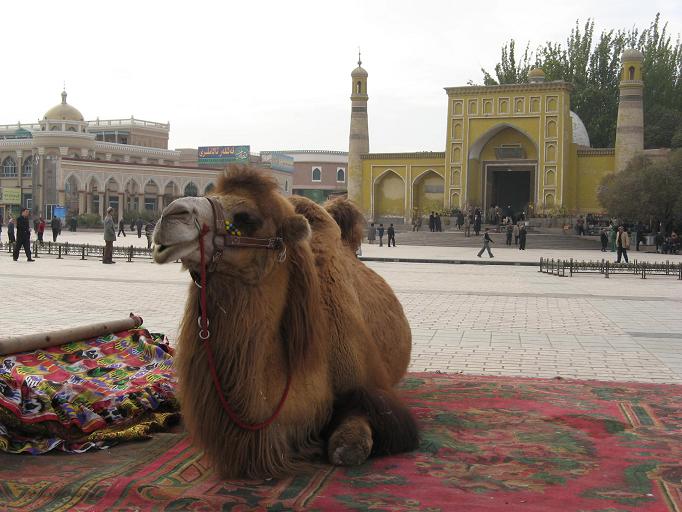
At Dunhuang I also bought myself a silk road souvenier, one of those little fluffy camels like in the picture at the top. Would have loved to have got a big size one, but sadly the back pack could not handle it.

Saturday, December 16, 2006

Coming Soon...

Still struggling to catch up as all my time seems to be taken up these days, But will update the rest asap...

Coming Soon...

Dunhuang (敦惶) - Mogao Caves and Ming Sha Shan (Sand Dunes).


Jiayuguan (嘉峪关) - The Western end of the Great Wall.


Lanzhou (兰洲) - The centre of China? Yellow river, Xuanzang & Monkey.


Xian (西安) - The Terracotta Army.


Nanning (南宁) - A Wedding in "China's Greenest City"

Friday, December 08, 2006

More Silk Road yarns from Turpan

I've not had much chance to write since leaving Khotan, but now I have some time, here's a bit of what's been going on since:

Last day in Khotan I made another attempt to visit the silk factory... The decision to go there again was rewarded with an enjoyful bus journey to the village where the factory was based, during which I was surrounded by young school kids, asking numerous times "What's your name?" which seems to be the only English sentence most children have learnt in school in Xinjiang province. The one exception was one young girl who had a little notebook of English phrases and would sneak a look in there then come back to me and ask something like "What's your telephone number?". Off the bus I had a quick game of football with some of the boys before going to the silk factory. After some effort I convinced the lady in the silk shop that I wanted to be shown around the factory. She obliged for 10 yuan and i was shown about 7 buildings each housing machinery and staff processing the different stages of silk production from selection/removal of good/poor quality cocoons, bathing them in hot water to help soften the raw silk before separation of the filaments, through to the final stage of weaving. A reasonable visit, but a shame noone there could speak any English, which would have made it far more worthwhile...

In the afternoon, i caught an overnight bus towards Urumqi, I was told by ticket desk and drivers to get off at some stop called something like Toloxan, to change for Turpan, which is where I wanted to go, I decided to skip Urumqi.. Journey was on a sleeper bus, first along the Southern edge of the Taklamakan Desert and then northwards straight across the centre on a highway built by the oil companies mining the oil resources in the desert. During the evening we stopped at a small village for dinner where while standing outside a cafe I was attracting the attention of two young girls. Whenever I caught them looking at me, they would embarassingly cover their faces and burst into a fit of giggles. Slowly they edged closer and closer and then started chatting to a man next to me, after a while one edged closer again, looked up at me and asked 'What's your name?". Their (English) names were Delilah and Alice and were probably about 8 or 9 years old. Delilah spoke a little English with a beautiful, clear English speaking accent, we exchanged a few questiond/answers in English and Mandarin and I sang her a bit of a song I know by a famous Welsh singer. I also know a song about a girl called Alice, but the currently popular version is not suitable to sing to a young child, so I left that out.

I was awoken early by one of the drivers and told to move seats to accomodate a family who wanted to be together, zzzz, soon after I was awoken again and told to get off. I looked around, was he talking to me ?, yes, I looked outside, but we were virtually in the middle of the desert, no bus stop here ! Just a couple of mining buildings. It turned out (or so it seems) that the drivers decided as I was the only one going to this particular stop, they would get me off here, rather than take the 20km or so diversion from the Urumqi main road to Toloxan and back again. Just throw the foreigner off here and just show him a cab... no amount of suggesting they take me to the bus station - as per my ticket - helped and i just had to resort to the fact I was off the bus and had to take a taxi to Toloxan, but nothing i could do really. So i reached Toloxan (or whatever it was called) and took a shared taxi and eventually arrived in Turpan...

Had been recommended a hotel here, only 40 yuan for a single room with bathroom, asked at reception but he said there were only rooms for 150 yuan ! or a dorm for 30, I mentioned the recommendation and questioned his pricing, but he would not admit any such rooms were available, so I took the dorm room, which was a bit like a prison cell. the toilets were 150m away across a courtyard and the showers which were next to the toilet were only open from 15:00 - 21:00. Later, someone else checked the dorm room and said she was also being shown a single room available for just 40 yuan, which is when I found out that prices seemed to depend on who was working at the desk. So the next morning, I asked then man who had served me the day before again, faced with more facts, he now admitted, there were cheaper rooms available !! So I left as I didn't like his hotel anymore ;)

Turpan (吐鲁番, Tulufan in Chinese) seemed a pretty friendly town, loads of kids in the streets would say hello to me and a couple of cafes even had English menus which was a stroke of luck. This is mainly due to a large number of tourist sites in the vicinity of Turpan, there is nothing in the town itself, but it is a popular base for visitors to arrange tours of the sites around. Though smaller, it had a similar friendly feel to Khotan, in that the number of foreign visitors seems still low enough that the locals have not yet reached the stage of treating foreigners with indifference and still see you as a bit of a curio.


Left: Emin minaret and mosque in Turpan.
Right: Ancient ruined city of Jiaohe.

During my short time in Turpan I found time to visit the Emin mosque/minaret which is in the middle of a field a couple of kilometres walk out of the centre and also the the ancient ruined city of Jiaohe. The ruined city was interesting as much of the design was still intact, remains of building and pathways were clear and gave a feel for what it might have been like there so many, many centuries ago.

Thursday, November 16, 2006

Along the Silk Road in China

Since Uzbekistan I have been passing along a route that includes many towns from the ancient 'Silk Road'. Leaving Kashgar, I moved along the Southern road of the Taklamakan desert that was also a well trodden route in the Silk Road days. From Kashgar I went to Khargilik (叶城, Yecheng in Chinese), there I stayed in the 'traveller's guest house' outside the bus station, as do most tourists by the look of the guest book. Strange thing there, I was a little bemused at first as the floor lady kept knocking on the bathroom door, but then I realised she was trying to demonstate that the bathroom light was sound activated. It was amusing how you could turn it on in different ways, shouting 'on' would switch the light on, so would shouting 'off' ! So did the knocking on my bedroom door late at night (which I guess were from ladies offering 'services'). Hi tech it sounds, but it did not fit in with the general appearance of the room, in contrast the shower had no real shower head, so the water just poured out like it was being pumped through a trumpet. The town had nothing of any special interest, just a historical note, it was almost entirely Uighur populated, very very few Han Chinese there, so lots of food stalls in the streets with various delicacies such as sheep's head.


Left: Traffic in Yarkand.
Right: Local Uighur people gather outside the mosque in Yarkand.

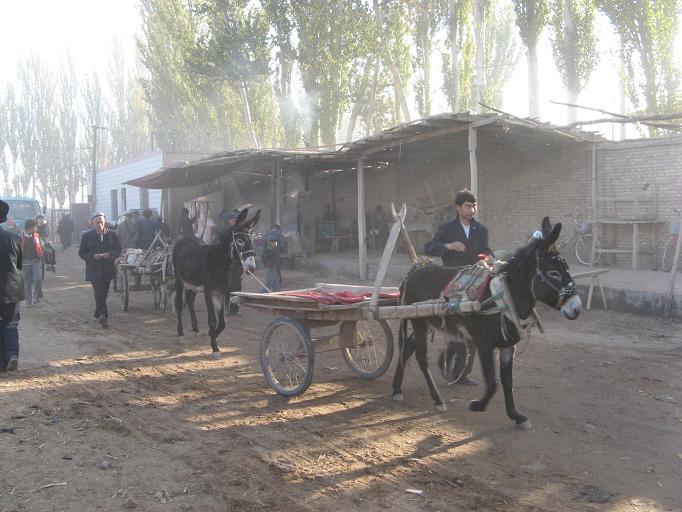
Next morning I took a bus backwards to Yarkand (沙车, Shache in Chinese), a bigger town half expanded by Chinese development, modern Chinese buildings, hotels, restaurants in one half, and the much more dusty but appealing old town area where the Uighur people hang out, big buzy bazaar, mosques, mausoleums and traditional old wooden houses. Many of those that were still standing looked like they were about to collapse or were abandoned, but the local way of life still went on as normal, selling food on the streets, animals wandering about, donkey carts and open trucks pulled by motorbikes whizzing around everywhere.

After a few hours I headed back to Yecheng, where if I could still catch a bus to Khotan I would, if not I would stay another night. On the way back (at a place I think was called Qinbag Zhen in Chinese Pinyin), the road was blocked, some big market going on, full of sheep, donkey carts, camels, food, quite an amazing site really. Took a while to get through but was worth the wait seeing all the animals, locals and the trading going on. In Yecheng there was a bus, almost full and so within 30 minutes of arriving it left and I was on yet another uncomfortable bus to Khotan. After some 8 hours on busses that day, my back hasn't been the same since.

Arrived in Khotan (和田, Hetian in Chinese) late at night and checked into the Traveller's guest house outside the station (again the same name, though this time translated to 'Traffic hotel'). Khotan is an old town renowned historically for its silk, jade and carpets trade. The next morning I moved to another cheaper hotel and walked around Khotan, took a bus to the silk factory, had trouble finding it and when i did they were closing. A pretty uneventful, unsuccesful day apart from finding a 'Western bakery' cafe that had all sorts of lovely sounding western foods on the menu, but out of all of them, only pizza was available, it was an OK pizza though and the waitresses there were ever so sweet and beautiful and found my attempts at communication incredibly funny. Today I moved to another hotel again (3rd in 3 days in Khotan) as yesterday's one had no hot water, this one is cheaper still, but actually better (I think so far). I was given room 102 which I could not find at first but then i discovered it, in between rooms 106 and 107 (of course!), and opposite 109, which was adjacent to 105.

This morning I visited the carpet factory and saw workers weaving carpets at quite impressive speeds, jumping columns along the loom without even thinking, knowing exactly where the next weave of that colour was to go. Very impressive skills on display and it seemed a nice atmosphere there, the ladies were working impressively but were still chatting amongst themselves at the same time. Only the sight of a strange foreigner watching, stopped them in their tracks. Walking back I stumbled across a jade market, I spotted crowds of people hanging around which usually signifies people selling mobile phones, but here it was jade. Quite a selection of stalls selling a variety of stones and other people just hovering around, pulling hands out of their jacket and showing you a handful of stones, like it was some kind of dodgy merchandise. A bit like my first ever visit to Amsterdam where you used to get approached all the time by dodgy men offering various drugs, but here the merchandise was just harmless stones. There was an amazing array of stones available and people asking ridiculous prices, but that was probably just a special price for the foreign tourist ! Some nice things but as I had no idea of value I resisted until I had done some more research. Further on I decided to pop down to the river where people were digging away with forks looking for jade stones, I chatted with a couple of people to see what they found and they had recoverd a few nice pieces, there were all sorts of people there, digging for their fortunes, old ladies alone, young girls with their babies, men in groups working as a team, obviously big business this. Final cultural visit of the day was to the jade factory to see workers carving and shining jade on their lathes, nothing special, but nice to see the environment in which it is being done. Some nice carved pieces available in the shop, but again far too expensive really. Later on, in the street, I bought a stone for 15 yuan, his starting price was 300 ! So shows how much they try to rip people off.


Top: The jade street market
Left: Khotan silk factory.
Right: Locals out seraching for jade on the river bed.

Tomorrow I have to make it to the silk factory again in the morning and then later, hope to leave for Urumqi (乌鲁木齐, Wulumuqi in Chinese) and Turpan (吐鲁番, Tulufan), North across the Taklamakan desert highway.

Wednesday, November 08, 2006

The Karakoram Highway to Pakistan

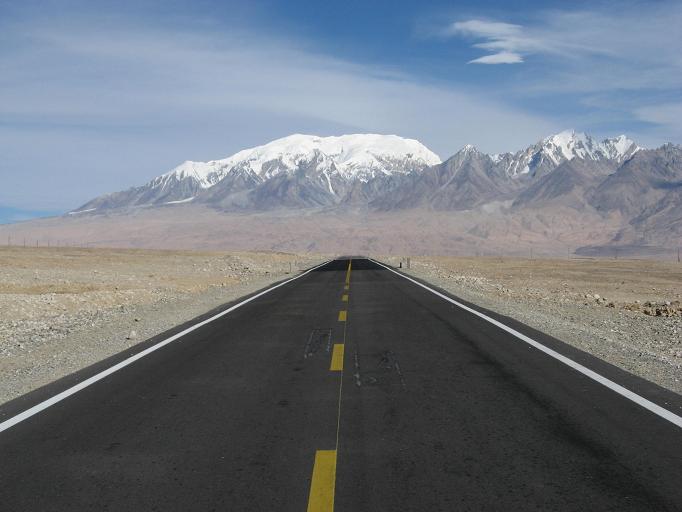
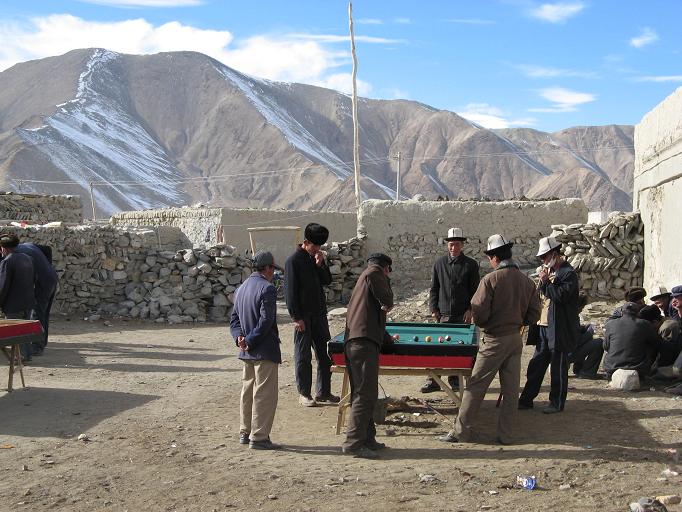
Just back from 2 and a half days along the amazing karakoram highway which stretches from kashgar 1300 km to Rawalpindi in Pakistan. Went as far as Tachkurgan the last town before Pakistan about 400km from Kashgar. At first the road is nothing special but after around 90 minutes you start climbing into the Pamir mountains that just stretch into this Western most part of China. Up and up you go, surrounded by mountains on both sides continuously. Past the highest peak of the Pamirs in China which is 7,546m high as the road reaches around 4,100m. Snow all around the mountain tops but surprisingly little on the ground at this altitude. All along the views are amazing and had to stop many times to grab photos. First day we went all the way to Tachkurgan where we stopped the night. There we saw a 600 yr old stone walled crumbling city, played pool in the streets with locals and made a brief visit to the local disco.


Left: Ancient stone city at Tashkurgan
Right: Villagers of Kyrgyz inhabited Karakul play pool.


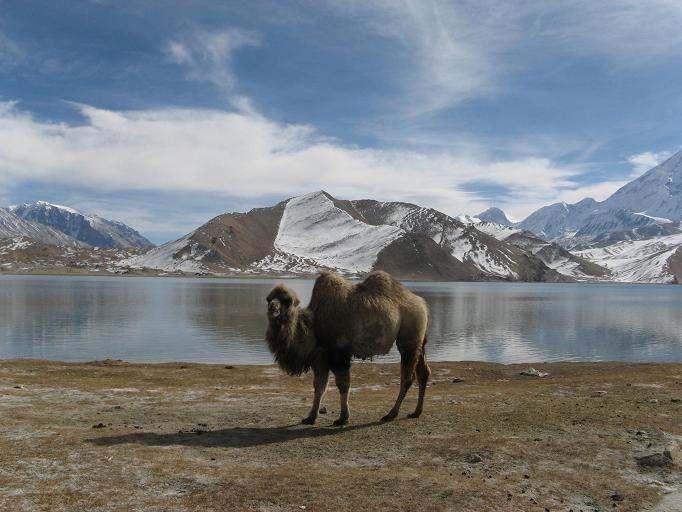
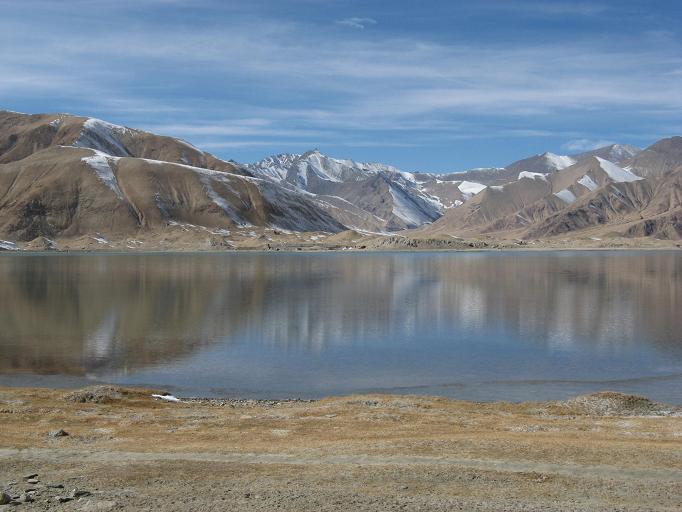
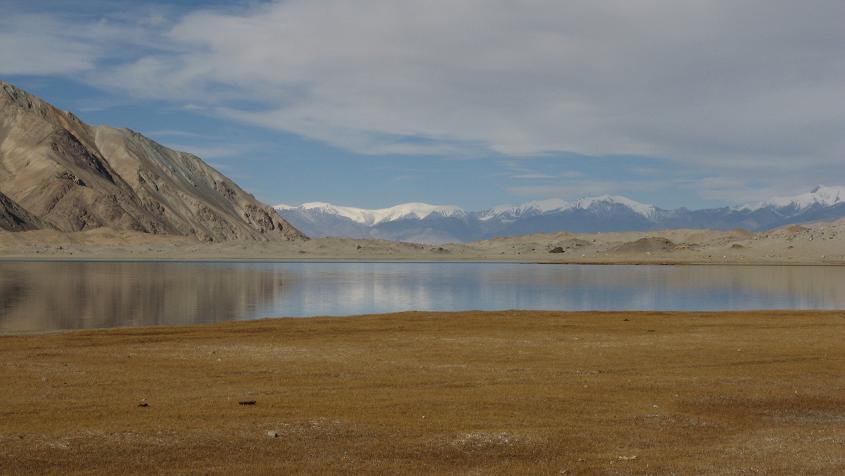
Top: Lake Karakul and a camel
Bottom: Lake karakul and the 7546m high Mt Muztagata in the Pamirs


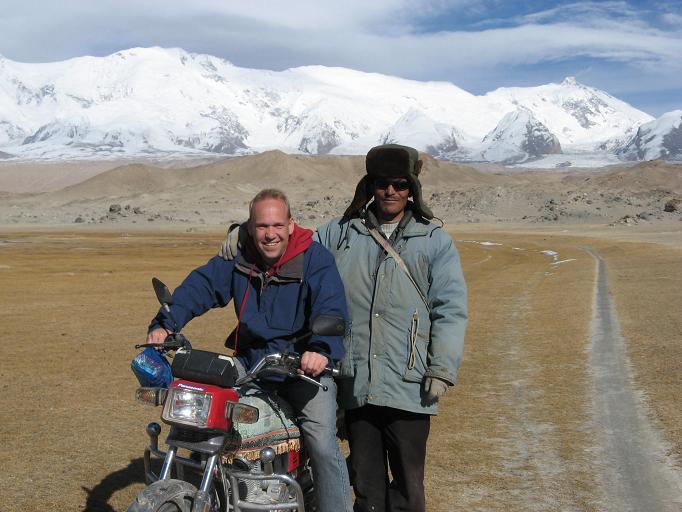
Left: motorbike and driver around part of lake Karakul
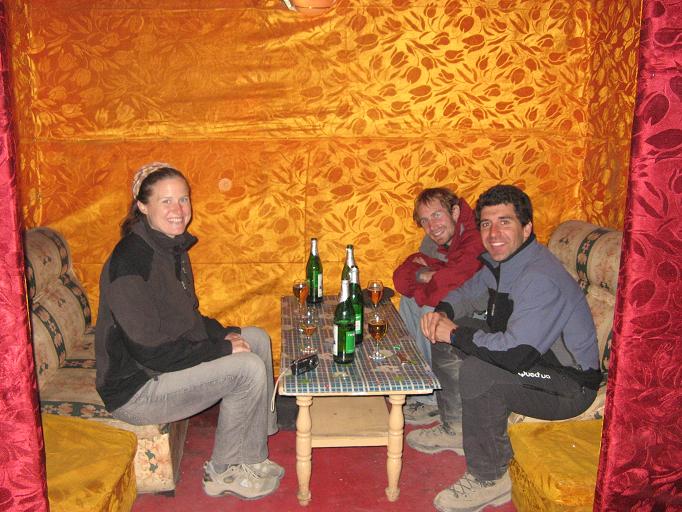
Right: Liah, Tom and Alarvo at the local disco in Tashkurgan


Next morning we headed back and stayed a second night by the beautiful lake Karakul with snowy mountains all around. Walked part way round the lake and did the rest on motor-bike when a passing local offered to take us around. Stopped in Karakul village - inhabited entirely by Kyrgyz people - where we were giving tea and nan. Then back to our camp which had a number of yurts and a stone house where we stayed and were fed and looked after by a local Kyrgyz family.. Around the mountains and lake I saw yaks, camels and sheep which were not in the least bothered by strangers wondering by. The tea was strange, made with yak's milk and a good helping of cooking fat, which may be good for people living at high altitude in cold weather, but doesn't taste so good to me!! The dinner was very tasty though...


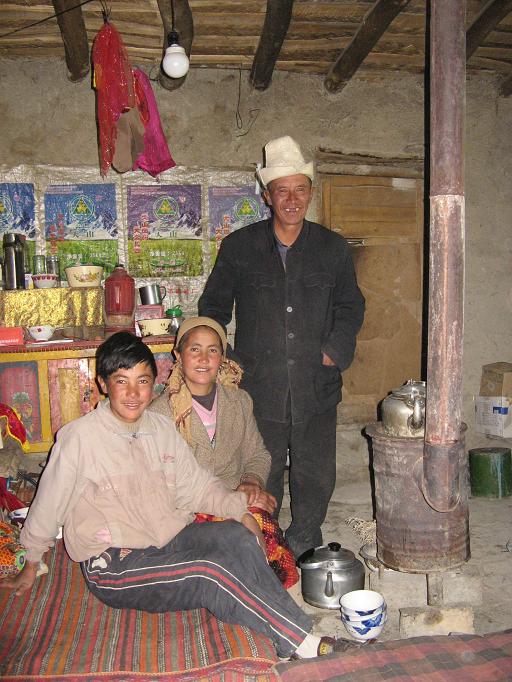
Left: Our family host at Karakul lake
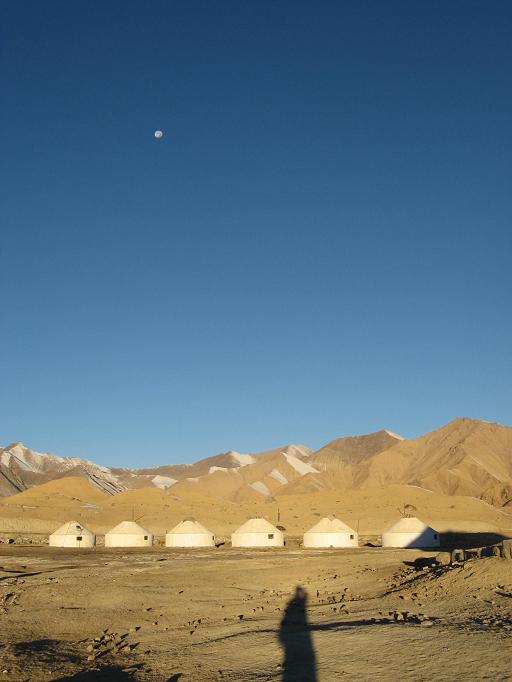
Centre: Easly morning at the yurt camp with moon still shining
Right: Entrance gate to Karakul village

Just seeing this section of the Karakoram highway is enough to make you come back to see the rest, it really is absolutely stunning....

Monday, November 06, 2006

Kashgar and the Sunday Market

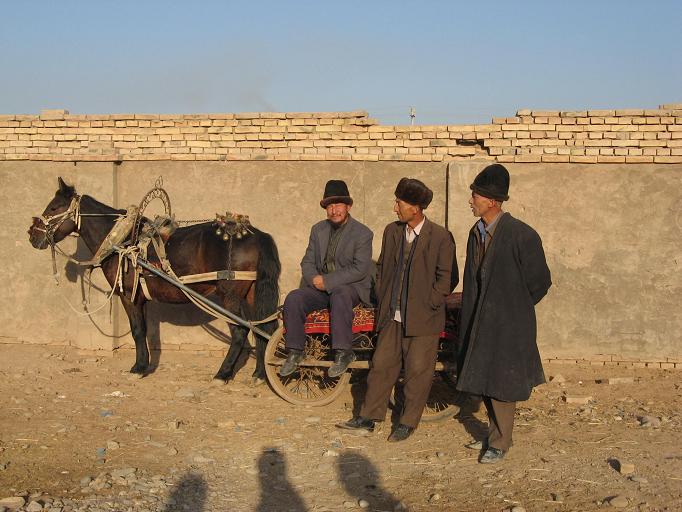
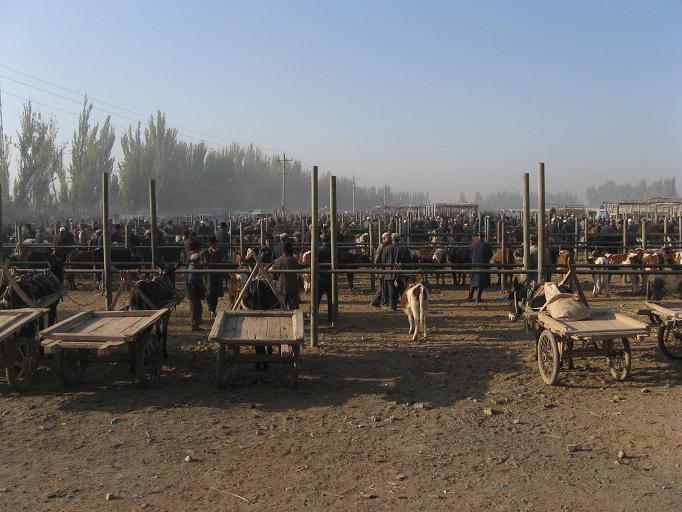
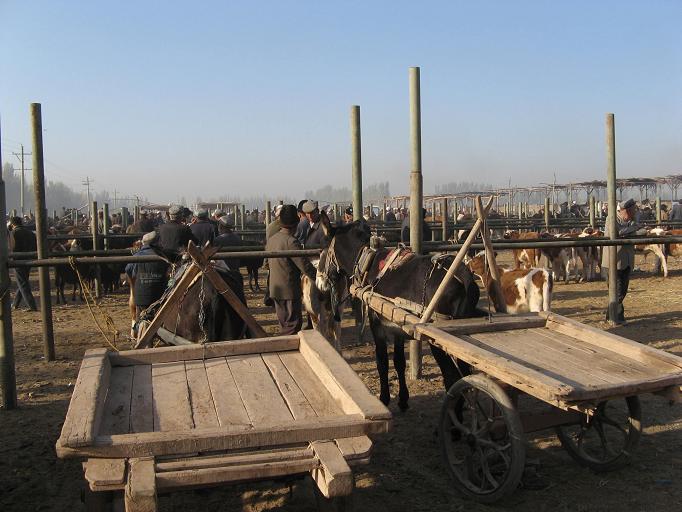
Visited the famous Kashgar Sunday market this morning, an animal market and bazaar. It was a little disappointing having read so many good things about it, but it was still something special, Rows and rows of animals lined up for sale, sheep, donkeys (with carts), camels and horses all available at a price, we were tempted to buy a camel, but did not have enough money for one, though it would have been cool.. The amazing thing was to see so many traders heading along modern Chinese highways with flocks of sheep and donkey carts. There is a real mixture of culture here in Kashgar, a real mix of old and new, there is an old town full of Uighur people who culturally and physically looking are Central Asian, buying & selling fruit, nuts, carpets and hats, eating shashlyk, noodles, laghman and other Central Asian foods from street stalls and then, the modern side full of Han Chinese shopping in modern shopping underground shopping centres and modern boutiques around the southern side of town, while at the same time Uigur people ride through on their donkey carts, which today being Sunday took over the whole city. Even late this evening, the roads had as many donkey carts trotting along as there were the green and white striped taxis.


Top Left & Right: At the Kashgar animal market.
Bottom Left: At the Sunday market.
Bottom Right: traders arrive at the animal market.

It's a really good city with such a mixture of culture, so much more modern than Central Asian nations, but still with a strong Central Asian influence, probably about 50/50 ratio these days. The people are very friendly and helpful and it makes it an easy place to hang aorund a while. Also helped by some great fellow tourists I have met; with Tony (Oz), JP (US) and Fuki (Japan) and also Stefan (France) we had a great night out in a couple of night clubs, one which was very Uigur, in fact there were only Uighur people there apart from us. This club had the bizarre idea that for a few hours during the evening, they would play only Turkic music which involved revolving around the dance floor anti-clockwise while dancing, something Tony and I tried and got quickly thrown off for not moving around enough and havning everyone bumping into us, as well as the fact that after every song the dance floor had to clear for a two minute break of 'other' music after which everyone could start dancing again. The other club was entirely Han Chinese who strangely favoured dancing around the tables, but it was pretty quiet and did not stay long. Also met Michael (Germany) who was on the bus form Osh to kashgar and who i had also met earlier in Bishkek, Tom and Dom from England, Freddy from Peru or Switzerland depending on his mood, and surprisingly today, again Oren and Magen (Israel) all of whom I also met in Bishkek over a month ago, we somehow ended up in the same cafe in the Sunday market.


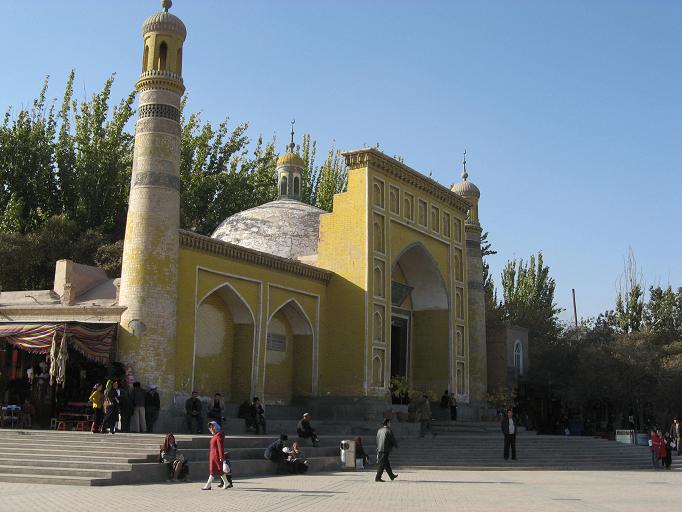
Left: Kashgar's Id Kah mosque.
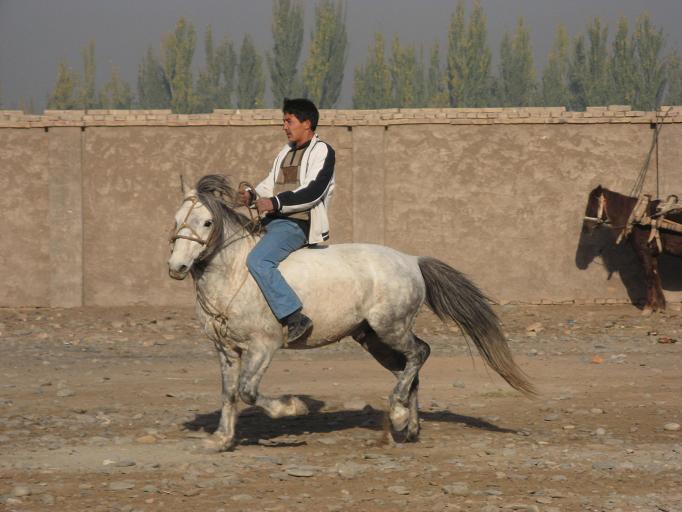
Right: Test drivinga horse at the animal market

Also spent a day in the Taklamakan desert with Eunmi form Korea, who amazingly has visited my home town of Haverfordwest; I was a little embarassed that I had not yet visited her town, the capital of Korea, Seoul; that was a nice day and she was the second person in two days I met who has been to Haverfordwest. Tomorrow I should be off to Lake Karakul and then Tachkurgan near the borders of Tajikistan, Afghanistan and Pakistan which is supposedly beautiful with the Pamir mountain range towering behind the lake at over 7500 metres high..


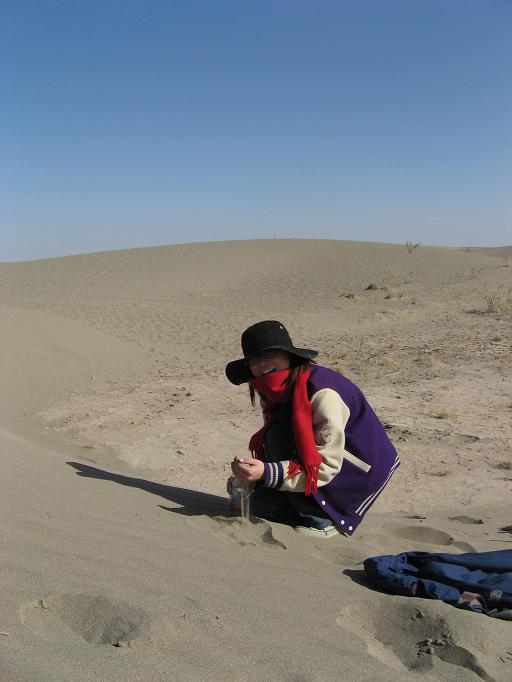
Left: Me & Eunmi in the Taklamakan desert
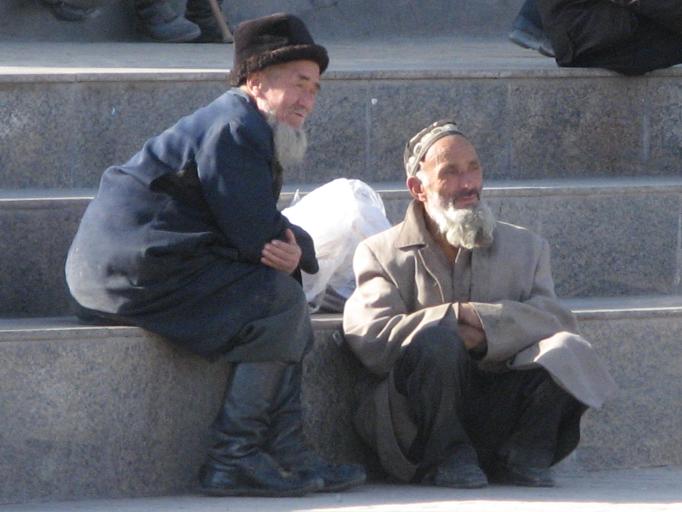
Right: Uighur men in Kashgar old town


While here I found someone to give me some Chinese Mandarin lessons (Puo tong hua) to brush up the few things I learnt in Amsterdam before I left, it's difficult for sure and nobody (except my teacher) has understood anything I have tried saying yet ;) but I hope thing will improve. It seems many tourists survive without any Mandarin at all, but it would be nice to be able to try some at least so I will probably stay a few more days when i return to be able to learn 'just enough' to get by when I move around the rest of the People's Republic of China (must get the name right !)

bye for now...